Can AI agents help my small business?
AI agents are everywhere this month, from Meta's Muse to OpenAI's dots. Here's what an AI agent actually is, which ones a small business can use today, and which hype to skip.
 Zachary Sheldon5 min read
On this page
The short answer: some of them, some of the time, but not the ones making the most noise this month.
If you’ve opened any tech news in the last three weeks, you’ve seen it. On September 8th, Meta launched Muse, a personal AI agent that can browse the web, fill out forms, shop, and check out with your card. It hit number one on the App Store in about ten days and passed three million downloads by the 24th. Three weeks later, on the 29th, OpenAI answered with “dots,” always-on agents wired into your work apps. The same week, a startup called Instinct raised a billion dollars at a ten-billion-dollar valuation, quadrupling its worth in about a month, while still being invitation-only. The word of the season is agent, and everyone wants to sell you one.
So here’s the honest question a small business owner should actually ask: can these things help me, today?
Why do many businesses hesitate with AI agents?
Strip away the marketing and an agent is simple to describe. A regular chatbot answers a question. An agent takes an action: it does a task, or a chain of tasks, on your behalf. Book the appointment, not just tell you how to book it. Reconcile the invoice, not just explain what reconciling means. That’s the whole idea, and it sounds fantastic.
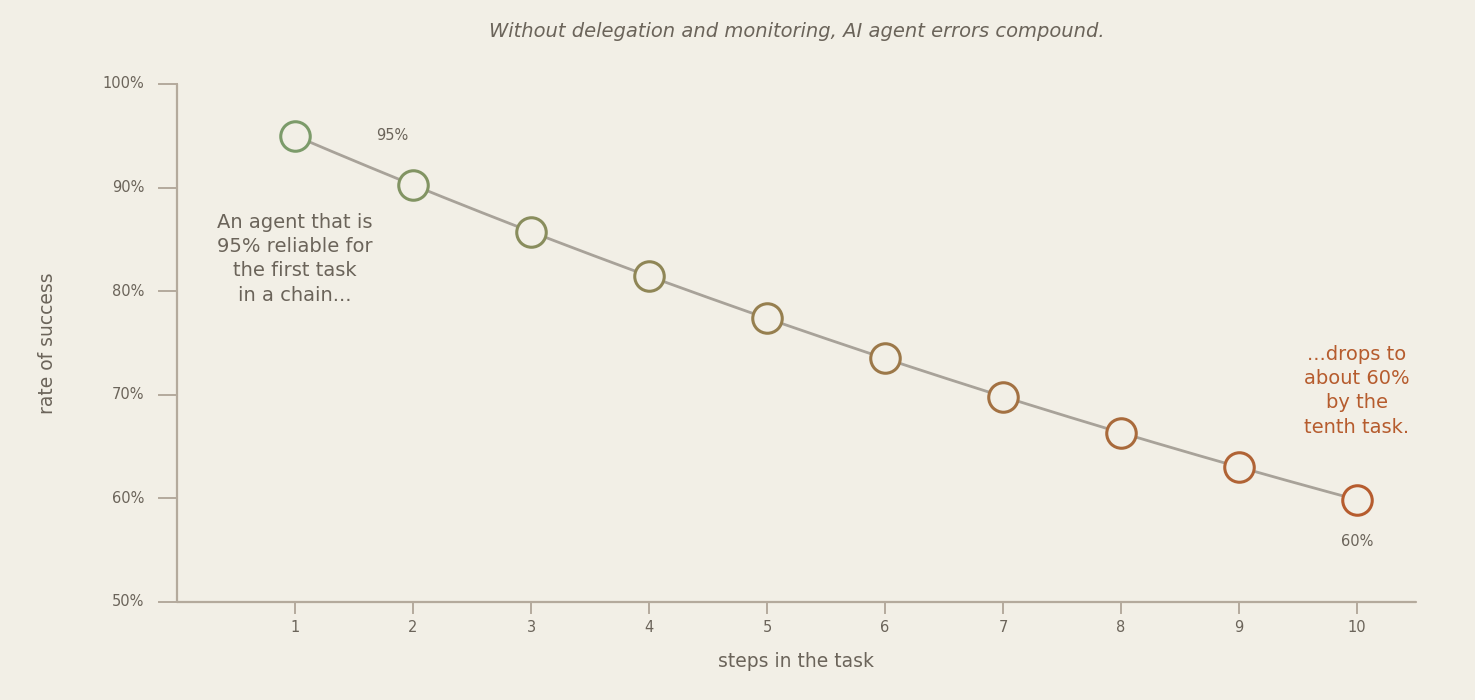
The trouble starts when one agent is asked to do everything as one long chain. Here’s the math the demos don’t show you. Say an agent is 95% reliable at each step, which is very good. String ten steps together into one workflow, and the odds it gets the whole thing right fall to about 60%. Real office tasks are long chains. That’s why a slick two-minute demo shows only set-up and promises, with less focus on outcomes and testimonials.
The industry’s own numbers back this up. Across enterprises, 80% of business apps now have an agent bolted on, but only 31% have one actually running in production, and 88% of pilots never make it that far. The research firm Gartner expects more than 40% of agent projects to be cancelled by the end of 2027 over cost and unclear payoff. Those numbers are good reason to be picky.
“Over 40% of agentic AI projects will be canceled by the end of 2027, due to escalating costs, unclear business value or inadequate risk controls.”
What agents help small businesses now?
Cutting through it, a few things are genuinely usable and affordably priced for a small shop today:
- Claude for Small Business (from Anthropic): pre-built workflows and connectors to tools you already use like QuickBooks and HubSpot, at essentially no cost beyond a normal subscription.
- Microsoft 365 Copilot Business: if you already live in Microsoft’s tools, the small-business tier runs about $18 to $21 per user per month, a real cliff below the $69 to $90 enterprise pricing.
- “AI Employee” tools like CellCog or Marbleism: accessible pricing, no per-seat minimums, automated loops.
And a few names getting enormous attention that I would not rush into: Muse for Small Business and dots are days old as of this writing, unproven at small-business scale. Instinct is a consumer concierge, still invite-only. Big valuations measure investor excitement, not whether the thing works in your business.
There’s even a live fight worth watching: Amazon has blocked Muse from acting on its store, the first real skirmish over which platforms will even let an agent transact on your behalf. If your storefront lives on someone else’s platform, that fight is your fight too.
In the next post, we’ll explore the extraordinary new technology that enables Aquarius to break down complex jobs into clear, accountable plans, to delegate those plans across multiple crew members, and to check each crew member’s work step by step, catching mistakes instead of inventing false answers. For now, if you take one thing away: agents can help your small business, but the useful ones are quiet, specific, and cheap, not the ones on the magazine cover this week.
FAQ: AI agents for small business
What is an AI agent?
An AI agent is software that takes an action on your behalf rather than just answering a question. A chatbot tells you how to do something; an agent does it, booking the appointment, reconciling the invoice, filling the form. Most are built on the same large language models behind ChatGPT and Claude, with added ability to use tools and browse.
Are AI agents reliable enough to trust with real work?
For single, well-defined tasks, often yes. For long multi-step workflows, be cautious. Reliability compounds: an agent that’s 95% accurate per step is only about 60% accurate across a ten-step task. Industry data shows 88% of agent pilots never reach production. The practical rule is to use agents for short, contained jobs and keep a person reviewing anything with real consequences.
Which AI agents are affordable for a small business today?
The genuinely small-business-priced options as of late 2026 are Claude for Small Business (little beyond a normal Claude subscription), Microsoft 365 Copilot Business (about $18 to $21 per user per month), and usage-based vertical tools like CellCog. Enterprise products like Salesforce Agentforce start far higher and add real implementation cost.
Should I adopt Muse, dots, or Instinct for my business?
Not yet. As of this writing, Muse for Small Business and OpenAI’s dots are only days old and unproven at small-business scale, and Instinct is an invitation-only consumer concierge. They’re worth watching, not betting your operations on. Start with tools that have a track record and a price you can predict.
Is a bigger, “do-everything” agent better than a specialized one?
Usually not. A single agent asked to do everything is one long, fragile chain, exactly where reliability breaks down. A narrow agent aimed at one job, or a system that splits work into pieces and routes each to the right tool, tends to be more dependable than one “super-agent” trying to do it all.
From our team to yours. Aquarius builds custom AI for individuals and small businesses. Learn more at peopleaquarius.com.