Can you trust AI agents with your work?
AI agents need delegation and supervision. Here's how we built a system that finds its own mistakes and keeps them from happening twice.
 Zachary Sheldon5 min read
On this page
Building a better system
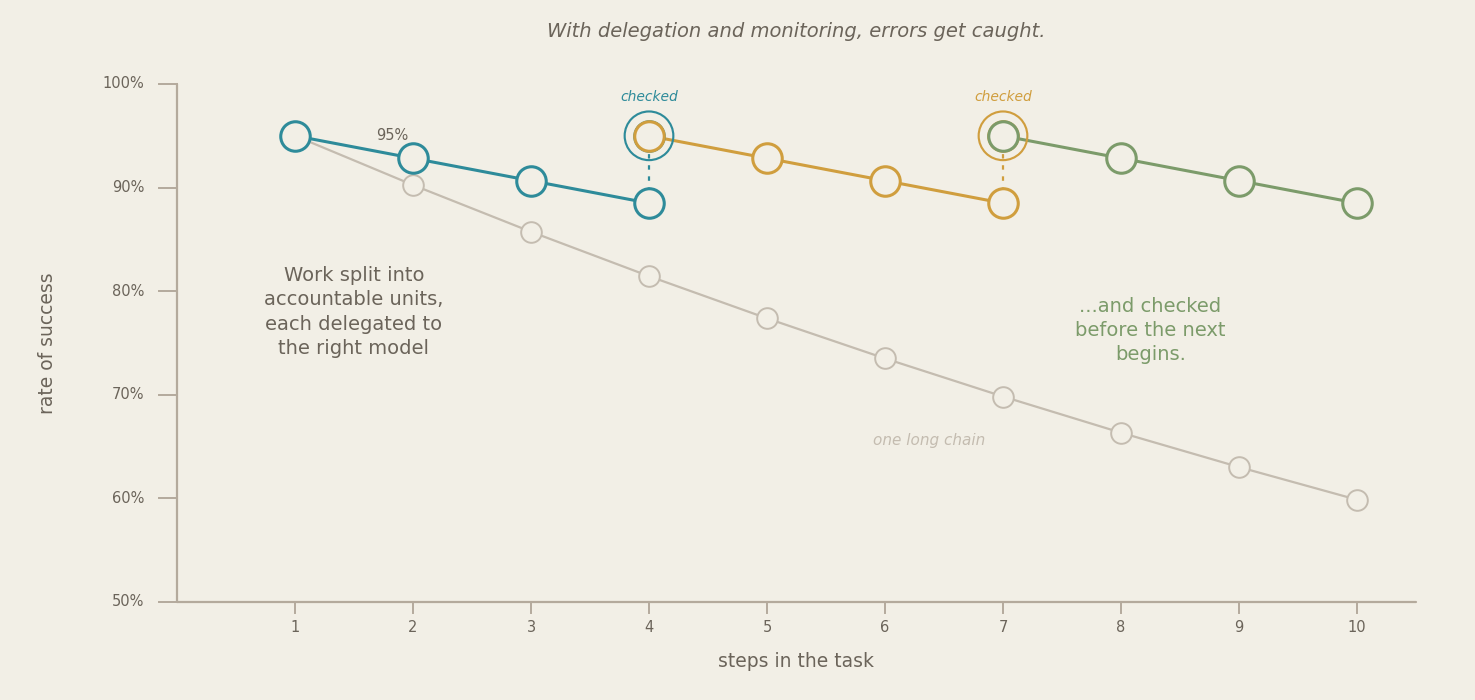
In the last post I showed you the math the demos leave out. An AI agent that’s 95% reliable on each step of a task isn’t 95% reliable across the whole job.
Real work is long chains, so a single do-everything agent is a fragile one. That post ended on a hunch: maybe the answer isn’t a bigger agent at all. Maybe it’s a system.
That word can sound like a dodge, so let me make it concrete, starting with a misfire from our own testing.
What safer AI really looks like
Every week brings another story about AI “agent swarms” slipping their leash in testing. The sensational version would have you believe AI is too big and too complex for any person to ever understand. That skips the question that matters for a business: when an AI system makes a mistake, does someone catch it, and does it keep it from happening twice?
How a system catches agents’ mistakes
Managing work well takes specialized knowledge. Underneath Aqua there’s what we call a world model: a collection of virtual objects that represents distinct aspects of cooperative labor (the task, who’s handling it, what’s true, what’s still owed) instead of one long blur of chat the AI has to re-read and hope it got right.
Because the work is held as virtual objects with a standard structure, the system can do three things that an out-of-the-box agent can’t.
The world model maps the job as separate, trackable steps, not one long chain where a slip anywhere ruins the end through compounding error.
Every step goes to the part of the crew built for it, instead of one generalist doing everything at once off repeated prompts.
A checking step reads each finished piece against what it was meant to produce. If it’s wrong, it’s caught and fixed right there, before the next step inherits the mistake.
The first two steps are why, even when the system makes a bad call, we can point straight at the piece of work that triggered it. The third is why a bad result gets caught where it happened, before it can compound into the steps that follow.
Memory that keeps the receipts
Every system of accountability requires record keeping. This is where almost every tool on the market falls short, even as they all advertise the same word: memory. What they mean by memory and what your business actually needs are not the same thing.
Most “AI memory” today is a single big box of notes. The Aquarius world model keeps a filing cabinet with labeled drawers.
- Past text pulled in because it looks similar to your request
- Information about you, not your business operations
- Loose notes, kept however the tool happened to keep them
- Stores what was said, not what was done
- What's true: your rules, prices, and people, held as the final word
- What happened: every action recorded as an event, not a sentence describing one
- Who does what well, and what's still owed
- Each thing in its own place, open to inspection and correction
The big box of notes is fine for recall. It can’t tell you what happened on Tuesday, because the box doesn’t separate notes with dated labels you can point to. An Aquarius Project run, however, comes with the filing cabinet: each step generates a run record that you or an AI manager can open and inspect.
That filing cabinet is what made our receptionist’s mistake findable in the first place. There was a recorded account of what happened in the task chain for the AI manager to locate and address. I’d call it an accountable record of operations, and its value reaches past trust.
Your Work, Your Model
Because Aqua’s model is standardized, and because it’s yours, it’s an asset. You can use it to run the business. You can share it, handing a contractor or a new hire exactly the slice they need. And when a business changes hands, the record of how it actually runs is part of what’s being sold. A box of chat logs can’t do any of that. You don’t want to hand that over, and you certainly can’t monetize it.
You don’t want AI that’s mysterious. You want AI that keeps records you can open, own, and pass on.
FAQ
So can I trust AI with real work or not? For short, contained jobs, often yes. For long multi-step work, only if there’s a system checking each step, not a single agent running the whole chain unsupervised. Trust the setup that can catch and fix a mistake, the way you trust plumbing that has shutoff valves, not the one that promises it will never leak.
What do you mean by a “world model”? It’s the part of our system that holds your business as a set of real, separate pieces (the task, who’s handling it, what’s true, what’s still owed) rather than one long stream of chat. Holding the work that way is what lets the system break a job into steps, hand each to the right part of the crew, and check each one before moving on.
How is that different from “AI memory”? Most AI memory stores what was said: past text it searches by similarity, or a profile of your preferences. That helps it sound consistent. It doesn’t give you a record of what was actually done, logged as events you can inspect and correct. The first is a box of notes; the second is a filing cabinet.
From our team to yours. Aquarius builds custom AI for individuals and small businesses. We made Aqua, your personal business wizard. It learns how you get things done, then uses our Working World Model to craft a crew of AIs shaped to fill your gaps. peopleaquarius.com