Which AI Model is Best for Your Small Business?
Sol or Astra? Haiku or Sonnet? Learn how to match the right AI model to each job, and how Aqua manages delegation so the right model just runs.
 Zachary Sheldon4 min read
On this page
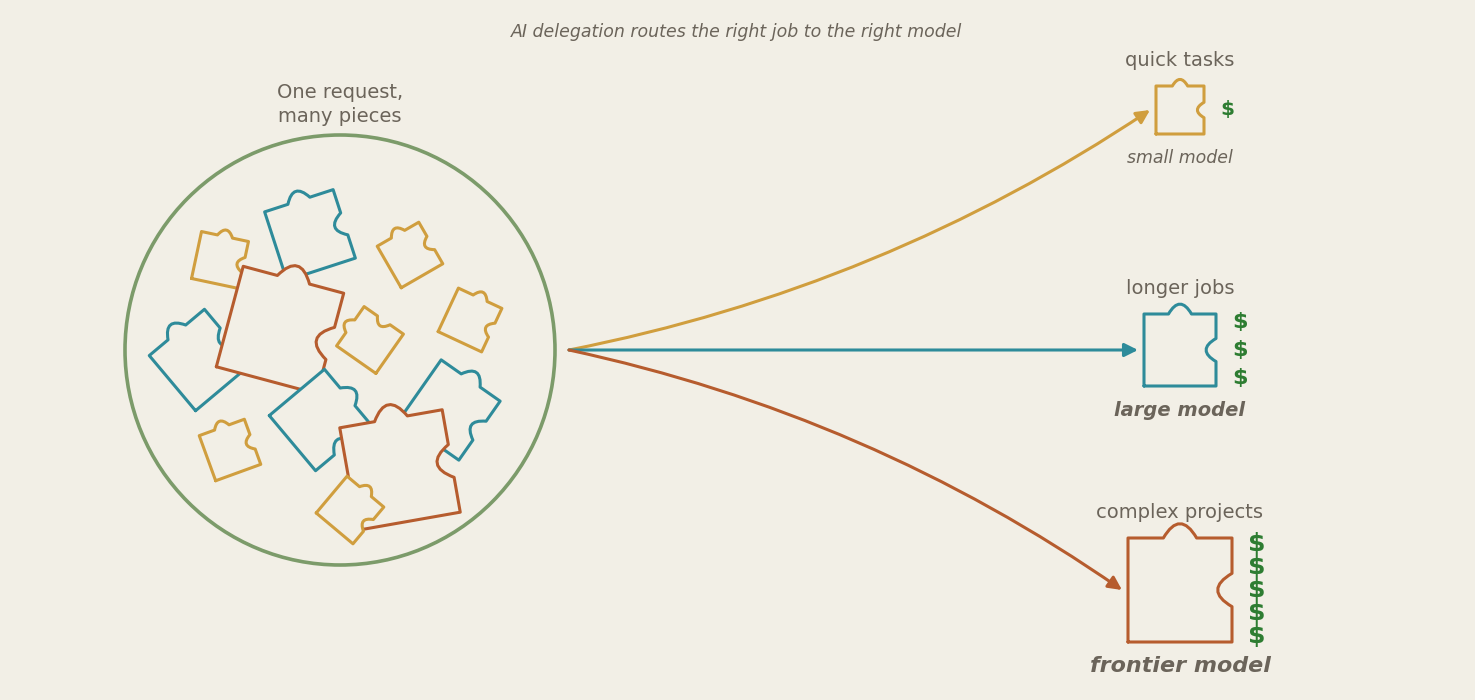
If you’ve ever wondered which AI model is best for your small business, the honest answer is that it depends on the job. Here’s how to choose, and how to stop having to.
If you subscribe to ChatGPT or Claude, you’ve probably noticed there isn’t just one version of their product. There’s a menu: a small, fast model (Claude’s Haiku, ChatGPT’s GPT-6 Luna), a bigger, more powerful one (Sonnet, and GPT-6 Sol), and the shiny new flagship everyone’s talking about (Opus, and GPT-6 Astra).
So picture yourself in the middle of a busy Tuesday, and you’re supposed to know which one to pick for the email you’re writing, the numbers you’re checking, or the product standard you need to research.
Those models are different tools. And like everything with technology, you want to choose the right tool for the job. Bigger isn’t always better, but paying for more power can be worth it when the task is genuinely hard.
Small, large, and flagship AI models do different jobs
-
A small model is quick and cheap. For a lot of everyday work, sorting a message, drafting a quick reply, pulling one number out of a document, it’s more than enough.
-
A large model is slower and costs more, but it can stick to a complicated problem step by step: reading a contract closely, working through a pricing decision, or generating a dense spreadsheet.
-
The flagship model is the strongest at coding apps and writing reports, but you pay for that power in speed and price.
How Aqua picks the right AI model for your work
Aquarius built Aqua to manage and delegate big jobs across multiple AI agents. And when Aqua can’t do a job on its own, it builds a new AI crew member to help.
Imagine you have a job to with both simple and complex parts, like relocating your business. Some parts are the right fit for small models, like searching for leases within your budget in a certain Zip Code. Other parts need more reasoning power, like reviewing agreements and generating projections on spreadsheets. You could do it all using a typical AI platform, but your work would be broken up across many isolated chats, each one running its own model.
Aqua works differently. You give it a big job to do and it breaks down each component in a Project map. When a piece is quick and simple, Aqua assigns it a lower-cost option. When a piece needs more effort, Aqua knows to activate it. You don’t switch between models, and you don’t manage subscriptions to five of them. You ask for the thing you need, and it gets done well and efficiently.
It’s the power of custom AI in something that feels as simple as asking a capable teammate for a hand.
peopleaquarius.comBuild Your CrewIf you’re already getting good work out of ChatGPT and Claude, that’s a real head start: you understand what these tools can do. The next step is letting AI help handle the delegation . From our team to yours, that’s what Aqua is for.
FAQ: choosing an AI model for your small business
Should I use a small or a large AI model?
Use a small, fast model (like Claude Haiku or GPT-6 Luna) for high-volume, everyday work: sorting messages, quick drafts, pulling a single fact from a document. Save a large model for work that needs careful, step-by-step reasoning, like reviewing a contract or a pricing decision.
Is a bigger AI model always better?
No. A bigger model costs more and runs slower, and for simple tasks it’s overkill, like using a jackhammer to hang a picture frame. The best model is the one that fits the job, not the largest one on the menu.
What’s the difference between ChatGPT’s and Claude’s model tiers?
Both offer a small, fast tier, a mid-sized capable tier, and a flagship. On ChatGPT that’s roughly GPT-6 Luna, GPT-6 Sol, and the flagship GPT-6 Astra; on Claude it’s Haiku, Sonnet, and Opus. The names change often; what matters is matching the tier to the task.
Do I have to choose the model myself?
Not with Aqua. Aqua’s Working World Model routes each part of a request to the model that fits it, so you ask for the outcome and the right model runs behind the scenes.