Why the AI Sell-off is Good News for Small Businesses
The Nasdaq's worst day since June has people asking if AI is a bubble. The bet on enterprise looks shaky, but don't count out big gains for small businesses.
 Zachary Sheldon10 min read
On this page
Markets Tumbled Last Week
On Thursday, October 22, the Nasdaq fell 2.6%, its worst day since June. Meta beat expectations and its shares still dropped 7%, because its AI spending gave it its first cash outflow in more than a decade. Chip stocks fell harder: the Philadelphia Semiconductor Index lost 6.7% in a day and finished more than 26% below its June high, according to Reuters.
So everyone is asking whether AI is a bubble. I think that’s the wrong question for anyone who runs a small business. The technology works. What looks shaky is the bet Big Tech made about what it would be used for. They bet AI would pay for itself by replacing workers who create deliverable goods. But the bigger gain is in the part of work that doesn’t produce ouptuts: the emails, the scheduling, the follow-ups and the handoffs. Small business owners are tired of bearing those costs, and they’re ready for a solution.
Why did AI stocks fall?
Reuters reported that earnings had raised fresh questions about how much is being spent on AI and what it will earn back. Investors are looking at the gap between the spending on data centers and the revenue that’s supposed to pay for it.
That revenue story has leaned on one idea for three years: AI will do the work people do now, so companies will pay for AI instead of payroll. Cut the cost of labor, and the savings cover the data centers.
On the same day the Nasdaq fell, new claims for unemployment benefits stayed near multi-decade lows. Whatever AI is doing, it isn’t emptying offices yet.
Is AI replacing office workers?
Not in a way the data can see. The OECD found about 1 in 100 AI-adopting firms had cut staff mainly because of AI. The Federal Reserve Bank of Minneapolis found about 96% of firms using AI reported no change in headcount.
Plenty of people use it: 23% of employed Americans used generative AI for work at least once a week by late 2024 (Bick, Blandin and Deming, NBER). But the time saved comes to about 1.4% of all work hours, a long way from replacing payroll.
Some of the investors writing the checks have moved off the replacement story too. Hannah Seal at Index Ventures sorts workers into three fates: “Some knowledge workers get relieved of drudgery, some get reinvented into new roles, and some, mostly doing fungible physical labor, get replaced outright.” Rhys Hughes at GV put it more bluntly this spring: “The future of work is more human, not less.”
Where is the real gain from AI?
Look at what people actually hand to AI. A study of how organizations use ChatGPT (Chatterji, Holtz and colleagues, August 2026) found the most common tasks are writing, communication and pulling information together. That isn’t the product a company sells. It’s the work of keeping everyone on the same page: coordinating.
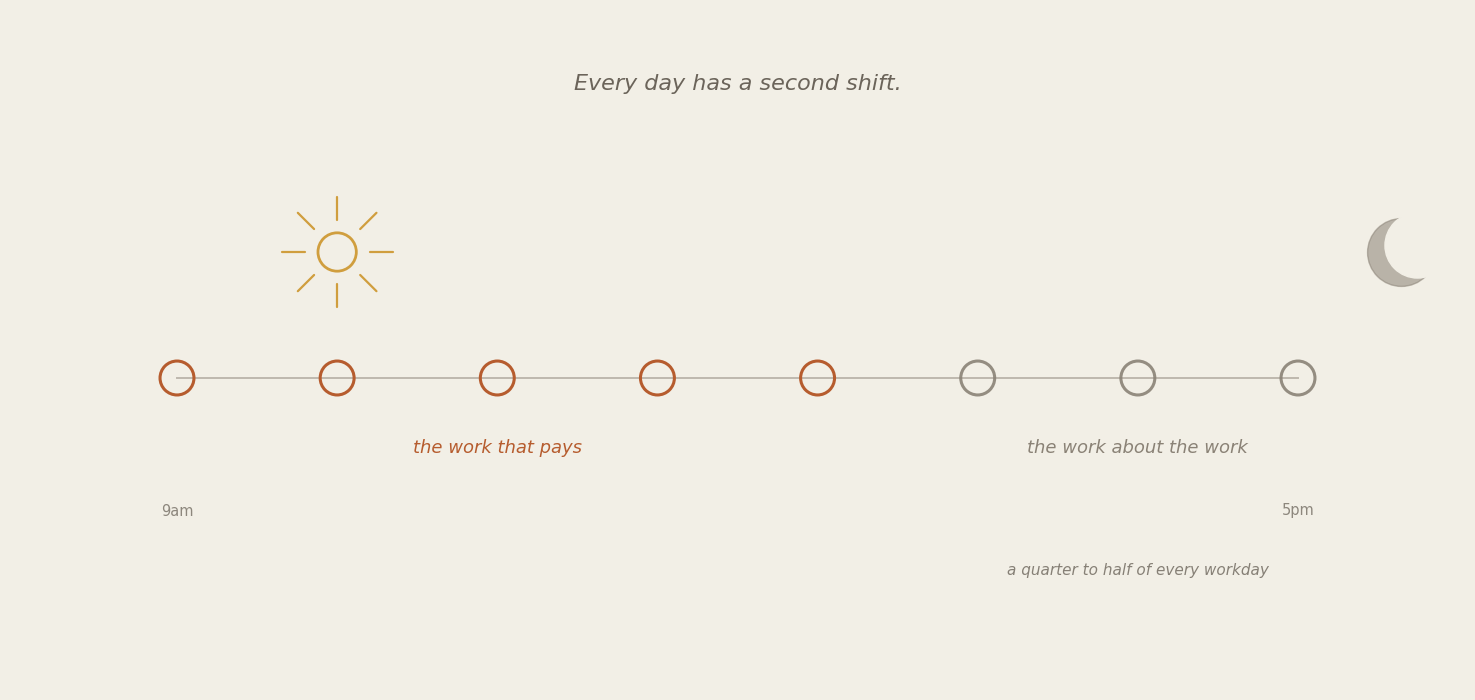
And there’s a lot of it. Somewhere between a quarter and half of all work goes to coordinating the work.
Management, business and financial operations, and office and admin support were about 26% of U.S. jobs and 33% of pay in 2024 (BLS). Knowledge workers say 58% of their day goes to “work about work” (Asana, 2022).
Where AI has raised productivity, it’s in that same territory. When a customer support team got an AI assistant, throughput rose 14% on average and 34% for the newest workers (Brynjolfsson, Li and Raymond, 2025).
Cheaper labor was the wrong target. The bigger prize is the quarter to half of the working day spent coordinating.
Why does this matter most for small businesses?
The economist Ronald Coase argued in 1937 that companies exist because coordinating through the market is expensive: finding people, agreeing terms, checking the work. Make coordinating cheap, and you don’t need a big company to do it.
Some venture investors now make the same case about startups. Nabeel Hyatt at Spark Capital argues for small teams over headcount: “A founder or manager can really track eight or nine direct reports before the picture gets fuzzy.” Semil Shah at Haystack says AI is changing “how much a small team can accomplish.”
That’s already happening. Census Nonemployer Statistics count businesses with no employees, and that number grew from about 24 million in 2015 to 30.4 million in 2023, up 25%. Jobs grew about 8% over the same years, according to the BLS.
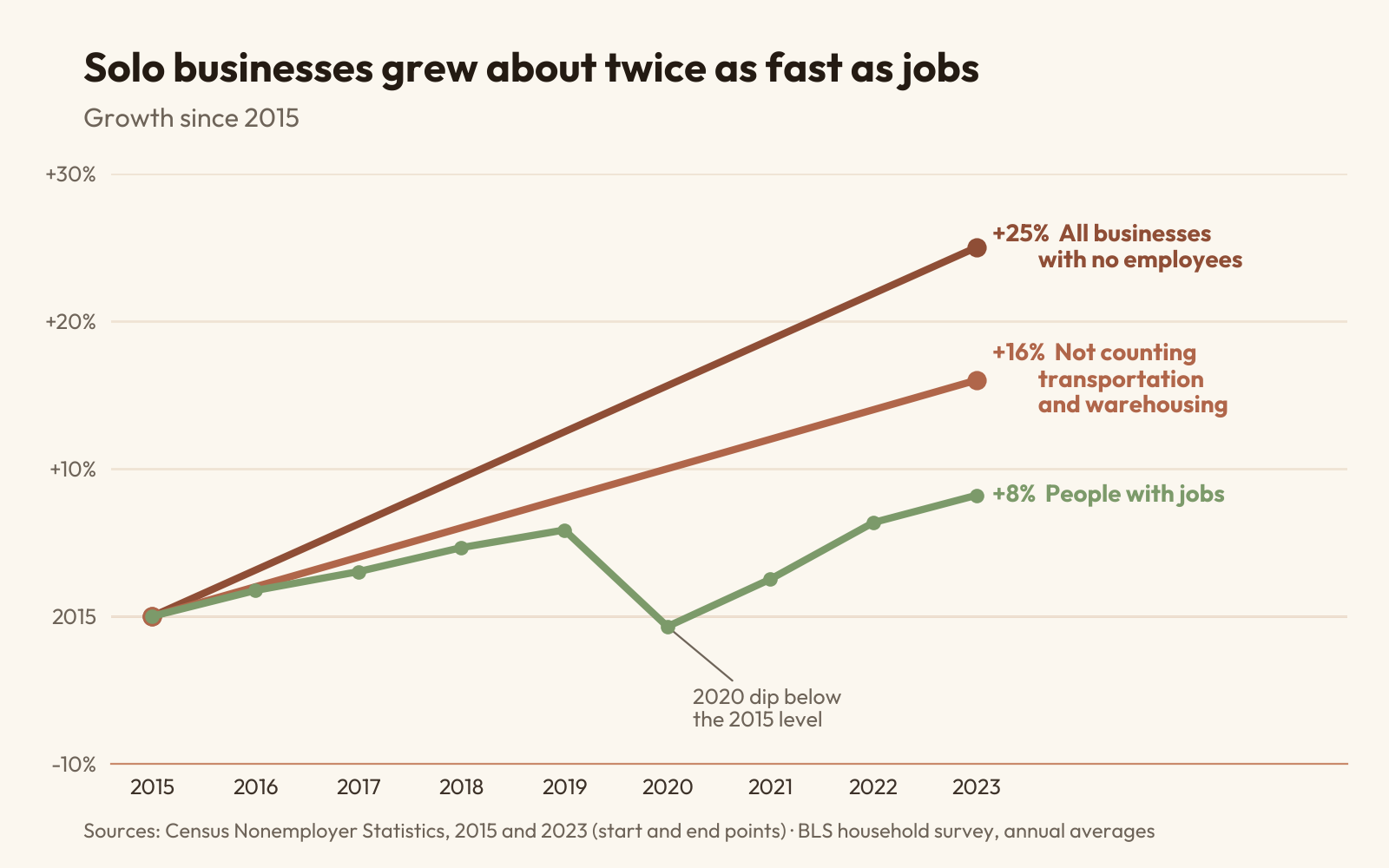
A big piece of that growth was ride-hail and delivery: solo businesses in transportation and warehousing went from about 1.5 million to 4.1 million. Take that sector out and solo businesses still grew 16%, about twice as fast as jobs.
According to the SBA, about 30 million of the 36.2 million small businesses in the United States have no employees. Those owners do every job themselves, and coordinating is the job they can least afford to hire for. A big company can hire an office manager. A tutor or a cleaner does it at 9pm.
And small businesses are picking up AI: the Minneapolis Fed found 17% of firms with fewer than 20 employees use it, against 30% of firms with 250 or more.
What have gig platforms cost small business owners?
For the last decade, a lot of that coordinating went to apps. My co-founder Peeyush Kumar describes the deal every gig worker made, whether they noticed it or not.
”[Platform workers] kept their skill. What they handed over was the customer.”
The platform took the work nobody wants to carry alone: finding clients, scheduling, payments, reminders, reviews, the awkward message when someone cancels. It was a back office, rented by the job. People paid for it with a slice of every job and with the relationship itself. The repeat booking, the referral and the reputation all stay on the platform when the worker leaves.
The coordinating is worth so much to whoever holds it because only the hours spent doing the work bring money in. Cut the hours spent coordinating, and the owner keeps more of every dollar.
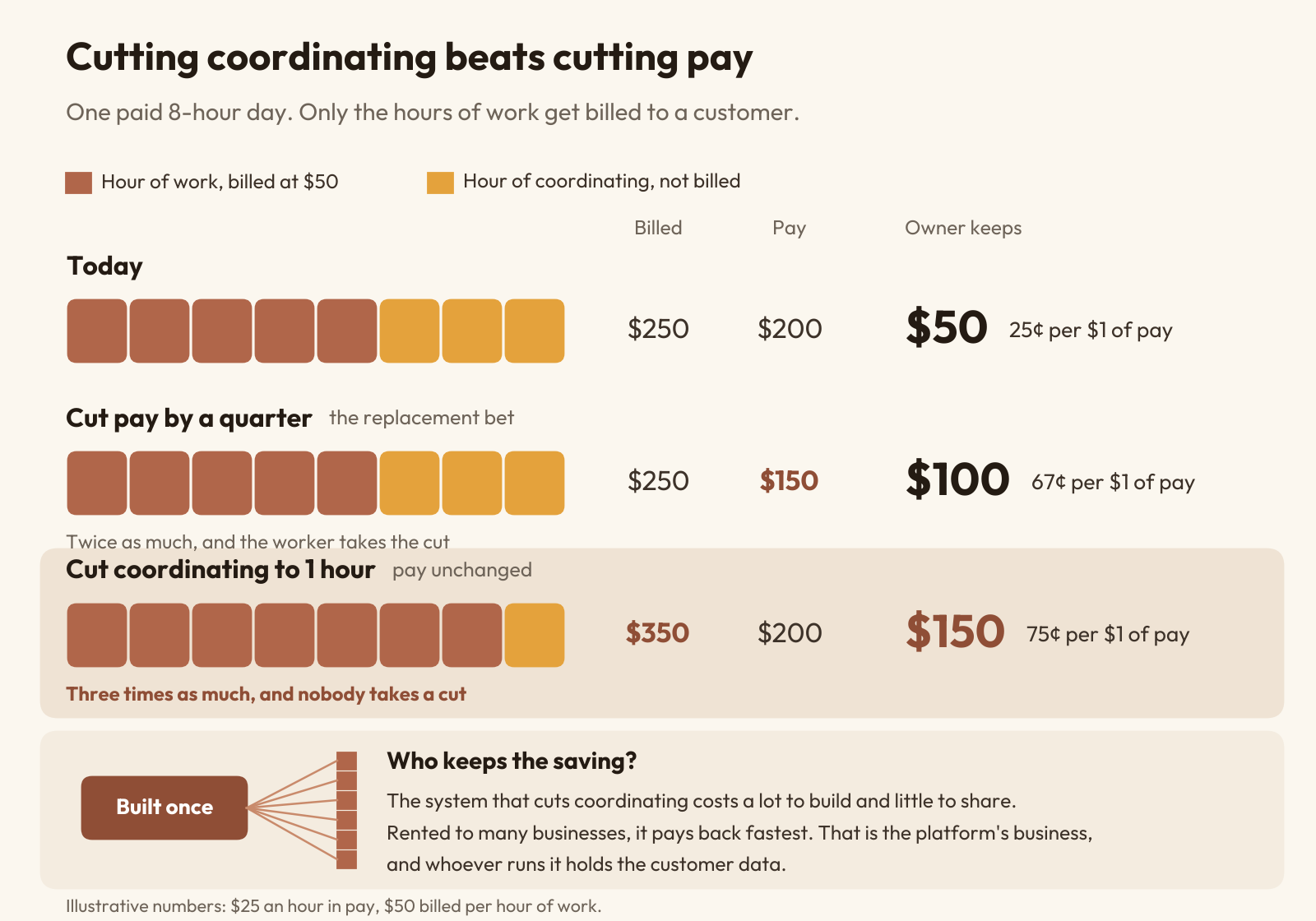
That’s the platform’s business: build the coordinating once, rent it to everyone, keep the data. Now AI can do most of that back office, so the trade is up for renegotiation.
Why aren’t AI employees enough?
Most of what’s sold as AI for small business right now is an AI employee: a tool with one job, like answering the phone or posting to social media. Those tools are useful. But an employee needs a manager, someone who decides what matters today, hands out the work and checks it when it comes back. In a business of one, that manager is the owner. Five AI employees can mean five new things to supervise.
Emily Man and her colleagues at Primary Venture Partners describe the problem well: “AI agents today are like new grads. Smart, eager, tireless, but with no knowledge of the job, the company, or the industry in which they’re meant to operate.” A new grad needs a manager. So does a whole crew of them.
For all the AI agents the big companies have released, they still aren’t giving people the kind of agency they want. An owner doesn’t want one more assistant to manage. They want what a firm gives you: someone keeping track, following up and getting things done on your behalf.
The decisions stay with the owner, and that’s the valuable part. KJ Sidberry and David Benjamin at GV wrote in April that as AI improves, “the cost of creation will continue to fall. But the cost of judgment will not.” James Detweiler at Felicis said it in a line I keep coming back to:
When thinking is cheap, value accrues to the things that were never computational to begin with: trust, judgment, presence.
Here’s how an AI employee compares with an AI business partner:
- Does one job it was set up for
- Waits to be told what to do next
- Leaves you to connect the pieces and check each one
- Knows how the jobs fit together
- Knows who's waiting on what, and what was promised
- Brings you only the decisions that need you
To do that, an AI has to hold a working model of the business: the people in it, the promises made to them, what’s due and what happened last time. I wrote about the difference between a real model of your work and a pile of saved notes in Can you trust AI agents with your work?
Where does Aquarius fit?
What we built at Aquarius is managerial intelligence. Aqua, the business partner, keeps a running picture of your working world: who you’re talking to, what you’ve promised and what’s waiting on you. Each crew member takes one job inside that picture, like sorting your inbox or running a project, so the jobs fit together instead of piling up on you.
Aqua doesn’t walk the dogs or tutor the kids. He keeps track of what’s done and what’s still owed. A lot of what he sends looks like email, but really it’s a report: proof of the work, a record for compliance, and a way to get paid for everything you did.
Aquarius is a platform too, so the difference has to be clear. A gig platform stands between you and your customer. Aquarius works behind you. Messages go out in your name, after you approve them. The crew earns more freedom through your own approvals, and every step is logged. I wrote more about that in AI Employees Still Need a Manager.
The picture Aqua keeps is yours. You can already download your Playbook and your maps and share them with anyone you choose. And we bill for the value of the work done, not for tokens, because the work is what you’re buying. Ryan Sells at Pear VC explains why that matters for anyone selling a service: “If you sell the outcome, the fish, every model improvement makes your service faster, cheaper, and harder to compete with.”
Whatever the Nasdaq does next week, the opening for small businesses is already here. Peeyush puts the payoff better than I can: the dog walker who becomes a small neighborhood institution, the tutor whose families stay with her for a decade, the cleaner who grows a crew of her own. That’s what we’re building for.
FAQ
Why did the Nasdaq fall on October 22, 2026? The Nasdaq fell 2.6%, its worst day since June, as earnings raised questions about how much is being spent on AI and what it will earn back, according to Reuters. Meta fell 7% after AI spending gave it its first cash outflow in more than a decade, and chip stocks fell 6.7%.
Is AI a bubble? Nobody can call that yet. What the sell-off questions is the bet that AI will pay for itself by replacing workers. The evidence so far shows AI is used most for coordinating work, like writing, communication and keeping track, rather than replacing jobs.
Is AI causing mass layoffs? Not so far. The OECD found about 1 in 100 AI-adopting firms cut staff mainly because of AI, and the Minneapolis Fed found about 96% of AI-using firms reported no change in headcount.
What are investors saying about AI and the future of work? Many are moving away from the idea that AI simply replaces workers. GV’s Rhys Hughes says “the future of work is more human, not less,” and Felicis’s James Detweiler argues that when thinking is cheap, value goes to “trust, judgment, presence.” Spark Capital’s Nabeel Hyatt and Haystack’s Semil Shah both make the case for small teams doing more.
How can a small business use AI? Start with the coordinating work: scheduling, follow-ups, invoicing, sorting email and drafting replies. That’s where AI is strongest today, and it’s the work a small business owner usually does alone after hours.
What’s the difference between an AI employee and an AI business partner? An AI employee does one job and waits for direction. An AI business partner keeps a picture of the whole business, including who’s waiting, what’s due and what was promised, so it can coordinate the jobs and bring the owner only the decisions that need them.
Can AI help a solo business owner keep their own customers? Yes. Most of what a gig platform does for a solo worker is back office work. AI can now handle that work for the owner directly, so the customer relationship stays with the person doing the work.